On the afternoon of November 21, Pan Yishan, Secretary of the CPC Committee of Liaoning University, delivered a thought-provoking, contemporary, and inspiring ideological and political theory lecture to doctoral students at the Puhe Campus. The lecture, held in the Report Hall of the Discipline Inspection and Supervision Building, was themed “Practicing the Spirit of Scientists: Being a Builder and Leader in the Liaoning Practice of Chinese Modernization”.
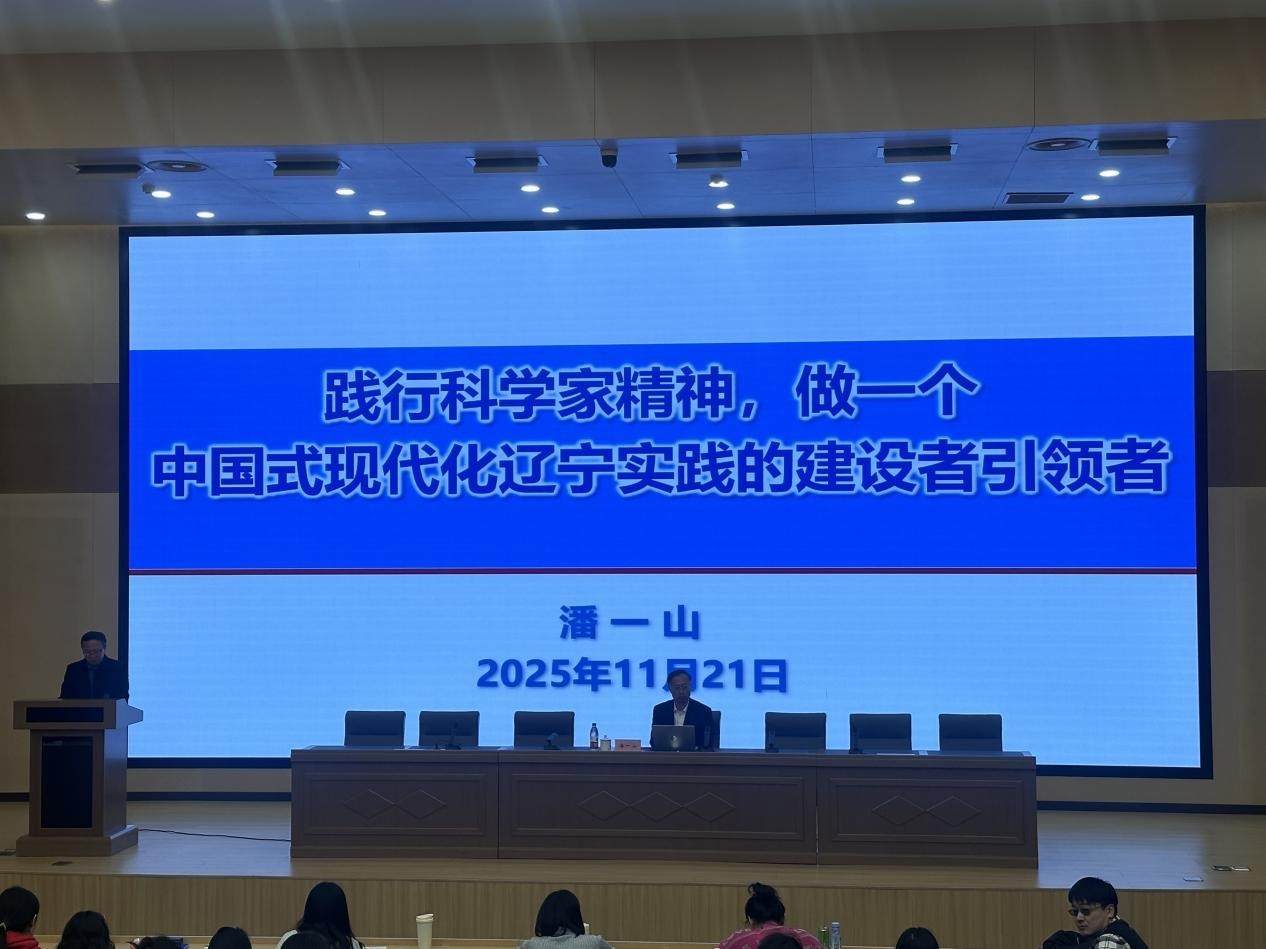
Secretary Pan structured his lecture around six key dimensions: “Upholding the Spirit of Scientists”, “Mastering Marxist Standpoints, Viewpoints, and Methods from the General Secretary”, “Cherishing Communist Ideals and Beliefs”, “Establishing the Concept that Moral Choices Are Economic Choices”, “Identifying Major Issues through Small Scenarios in Liaoning’s Modernization Practice”, and “Cultivating Ten Good Habits”.
Drawing upon the moving stories of renowned scientists such as Qian Xuesen, Chen Jingrun, and Tu Youyou, Pan vividly interpreted the profound essence of the spirit of scientists. He emphasized that this spirit — defined by patriotism, innovation, pragmatism, dedication, collaboration, and education — has integrated into the spiritual pedigree of Chinese Communists and serves as a fundamental guide for scientific professionals and all talents.
Closely aligning with General Secretary Xi Jinping’s discourse on technological innovation, Pan noted that innovation is a critical variable in the “great changes unseen in a century”, a core element of Chinese modernization, and the primary engine for developing new quality productive forces. He analyzed characteristics such as the high permeability and high growth potential of technological innovation, revealing the inevitable transition from a “following” to a “leading” mindset, and from traditional pathways to scenario-based applications. He summarized the road-map for developing new quality productive forces with the maxim: “Innovation is the lead, data is the foundation, computing power is the bedrock, transformation is the path, and talent is the support”, while elaborating on the significance of Liaoning’s role in Chinese modernization.
Pan placed special emphasis on mastering Marxist methodology, particularly the “problem-oriented” approach. He guided students to uphold the highest standards of academic integrity as an inviolable baseline and to view “moral choices as economic choices”. Using the premise that “problems are the starting point and motive force of innovation”, he systematically explained the standard research paradigm: “Topic → Social Reality Scenario → Real Problem → Cause Analysis → Countermeasures”. He encouraged the doctoral students to delve into social realities, discover “big issues within small scenarios” amid Liaoning’s revitalization, and effectively “write their papers on the vast land of the motherland”. His aim is for students to enhance their ability to solve practical problems, unifying their service to Liaoning with their service to the nation.
In his concluding remarks, Pan offered advice to the young scholars, urging them to cultivate ten lifelong habits, including “learning by doing”, persistence, and focus. He specifically highlighted the need to shift from “purely theoretical work” (paper-to-paper) to “direct practical engagement”, and to always maintain a grateful heart. He expressed his hope that students would internalize the spirit of scientists and translate it into action, growing into courageous innovators and leaders capable of shouldering the heavy responsibility of national rejuvenation.
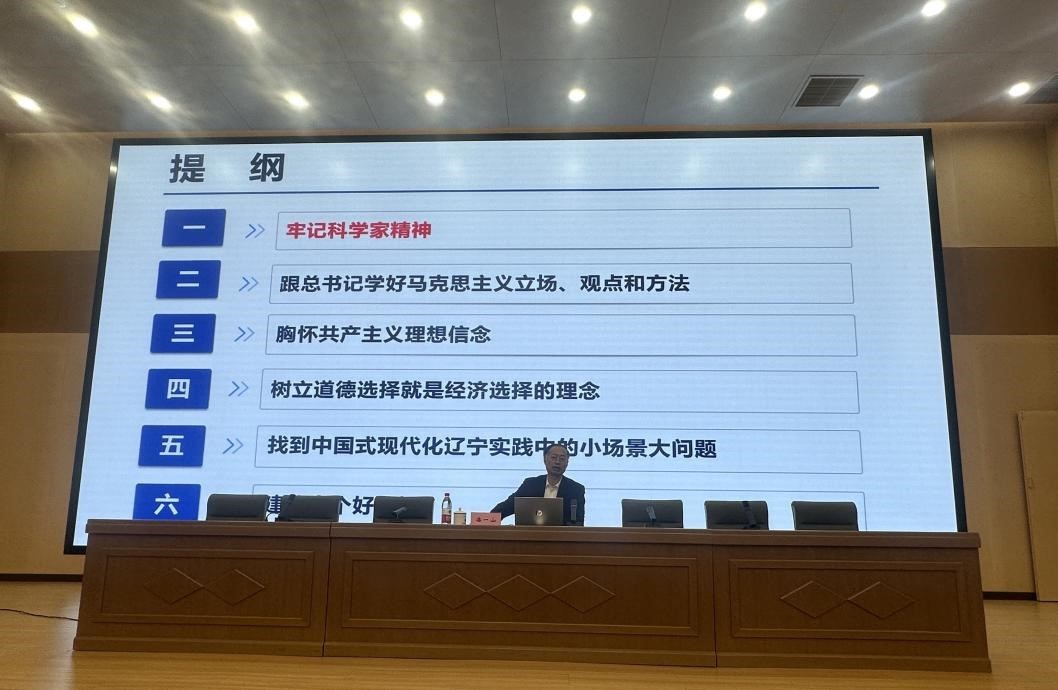
The lecture, characterized by profound theory and vivid case studies, provided both ideological inspiration and practical methodological guidance. Following the session, the doctoral students expressed that they would take the spirit of scientists as their compass. They pledged to remain grateful to, keep pace with, and lead the era, integrating their academic pursuits into the broader picture of Liaoning’s revitalization and contributing their youthful strength to the construction of Chinese modernization.