(KUALA LUMPUR, 9th) — Professor Yu Miaojie, President of Liaoning University (LNU), pointed out that China’s economy is transitioning from a stage of rapid growth to one of high-quality development. This transitional experience serves as a vital reference for developing countries, including Malaysia, particularly in avoiding the “middle-income trap”.
Speaking in an interview after attending a public lecture at the Institute of China Studies (ICS), Universiti Malaya, he noted that the key to high-quality development lies in maintaining a high level of Total Factor Productivity (TFP).
“If Total Factor Productivity can be maintained at a high level, it will help developing countries avoid falling into the middle-income trap,” he said.
He explained that economic stagnation in middle-income countries is caused by a lack of productivity advancement. These countries rely solely on factor inputs—such as capital, land, and labor—to drive growth, without achieving development rooted in technological progress.
“If the enhancement of Total Factor Productivity can be realized at the enterprise level, falling into the middle-income trap can be effectively avoided.”
He further pointed out that this is especially crucial for Malaysia, which must make boosting enterprise productivity a key strategic direction.
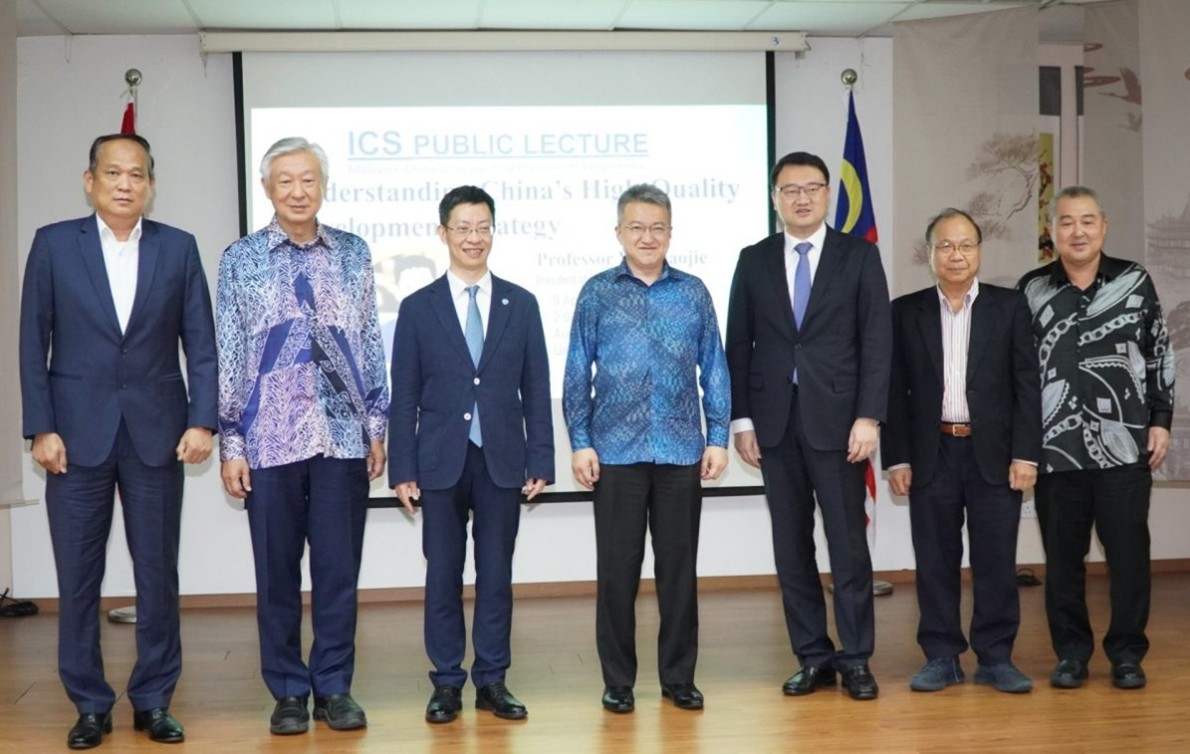
Yu Miaojie (third from left) poses for a group photo with attending guests after the lecture. From left: Datuk Tay Swee Gim and Low Kian Chuan; from right: Tan Tian Meng, Woo Wing Thye, Wu Jun, and Liew Chin Tong.
Government Should Play a Greater Role
“For Malaysia or other developing countries, a very important aspect is realizing the growth of Total Factor Productivity within enterprises.”
He emphasized that technological progress is far more important than merely increasing factor inputs like capital, land, and labor. This is because such inputs have a ceiling, whereas technological progress can sustainably drive economic development.
Earlier, during his public lecture titled “Understanding China’s High-Quality Development Strategy”, he pointed out that one of the keys to China’s push for high-quality development is upholding innovation as the primary driving force, continuously increasing research and development (R&D) investment, and fostering the growth of emerging industries.
Yu Miaojie also observed that at the enterprise level, the companies most active in innovation investment are neither the top-tier nor the bottom-tier enterprises, but those positioned in the middle. Facing more intense market competition, these mid-tier enterprises often increase their R&D investments to boost competitiveness, thereby breaking away from homogeneous competition.
Regarding the mechanism for R&D investment, he noted that different types of innovation require the participation of different entities. For innovation activities involving large-scale investments and higher risks, the government should play a greater role; meanwhile, widespread corporate participation should be encouraged for technological improvements.
Other guests attending the event included Deputy Finance Minister Liew Chin Tong; Tan Sri Low Kian Chuan, Chairman of the Malaysia-China Business Council (MCBC), and its Chief Executive Officer Dato’ Tan Tian Meng; Wu Jun, CEO of Bank of China (Malaysia) Berhad, and Deputy CEO Datuk Tay Swee Gim; as well as Professor Dato’ Dr. Woo Wing Thye, Visiting Scholar at the Institute of Advanced Studies, Universiti Malaya.
Original Link:
https://www.enanyang.my/news/20260409/Finance/1217074