On March 12, 2026, the Fourth Session of the 14th National People’s Congress voted to adopt the Ecological and Environmental Code of the People’s Republic of China (hereinafter referred to as the Ecological and Environmental Code). As the second law named a “Code” following the Civil Code of the People’s Republic of China, the Ecological and Environmental Code is a milestone in China’s rule of law system for ecology and the environment, and will also have a profound impact on the development of the global environmental governance system. Notably, the Ecological and Environmental Code independently dedicates a part to “Green and Low-Carbon Development,” a pioneering initiative globally, providing an important reference and practical example for countries worldwide, especially developing nations, to effectively address climate change and achieve sustainable socio-economic development.
To widely disseminate the Ecological and Environmental Code to the world, the latest achievement in China’s ecological and environmental rule of law, at 19:00 Beijing Time on March 19, Professor Liu Jiaqi from the Law School of Liaoning University (LNU) was invited to deliver a special report titled “China’s Renewable Energy Legal System in the Era of the Ecological and Environmental Code” for faculty and postgraduate students from Brazilian universities and research institutions, including the Federal University of Paraíba-UFPB. Professor Ana Paula Basso from the Center for Legal Sciences of the Federal University of Paraíba-UFPB, and Professor Ma Haitian, Vice Dean of the Liaoning Intellectual Property School of LNU, jointly hosted the event online and delivered opening remarks respectively.
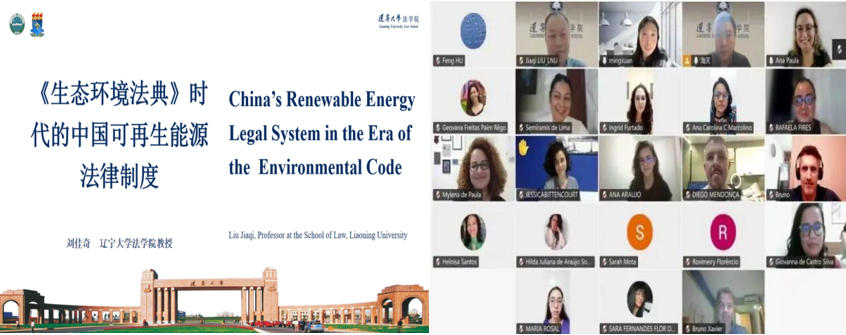
Based on the relevant provisions of the “Green and Low-Carbon Development Part” of the Ecological and Environmental Code, Professor Liu Jiaqi delivered a lecture focusing on the development of the renewable energy industry, the advancement of renewable energy utilization technologies, the substitution of traditional fossil fuels, the consumption and integration of renewable energy, and the international cooperation as a whole. He particularly highlighted the latest stipulations concerning renewable energy in the Ecological and Environmental Code. Following the lecture, Brazilian faculty and students engaged in a lively discussion with Professor Liu on topics such as the environmental and social value of developing renewable energy, the legal concepts of renewable energy versus new energy, and the protection of the legitimate rights and interests of relevant entities in its development. LNU highly values and has long been committed to the cause of legal publicity and education in China. After the compilation work for the Ecological and Environmental Code commenced, the university proactively arranged related promotional activities. It organized high-quality faculty to conduct special lectures and training sessions in advance for provincial-level people’s courts, procuratorates, public security organs, as well as legal and arbitration systems in cities like Shenyang and Dalian, covering themes such as ecological and environmental justice, legal services, diversified dispute resolution mechanisms, and corporate environmental protection responsibility systems in the era of the Code. This external dissemination activity on the Ecological and Environmental Code is not only an innovative measure by LNU to continuously support the Code’s promotion efforts, but also another significant landmark achievement in telling China’s rule of law story in the new era and projecting China’s legal voice to the world.