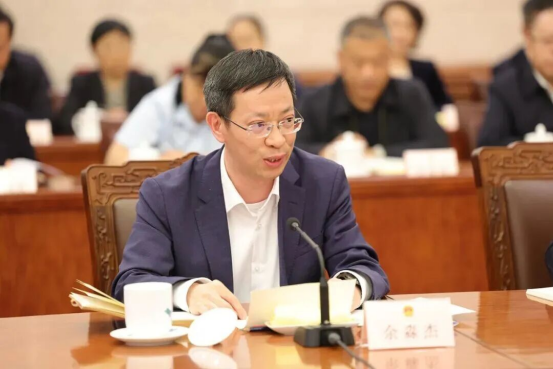
On April 29, 2026, Zhao Leji, Member of the Standing Committee of the Political Bureau of the CPC Central Committee and Chairman of the NPC Standing Committee, attended the meeting of the 22nd session of the 14th NPC Standing Committee. During the symposium with NPC deputies, including Ma Bing, Li Guangxia, Zheng Jie, Yu Miaojie, Zhao Jing, Qi Xiumin, Yuan Silang, and Li Shengpo. They delivered speeches and offered suggestions in light of their respective work, focusing on the implementation of the guiding principles of the Fourth Session of the 14th NPC.
The 15th Five-Year Plan period is a critical phase for consolidating the foundation and making comprehensive efforts to basically realize socialist modernization. The development environment is facing profound and complex changes, with strategic opportunities and risks and challenges coexisting. Accelerating the formation of a unified national market and promoting a new pattern of independent opening up are practical necessities based on national conditions and directly addressing challenges.
At present, the fundamental internal cause of enterprises’ involution competition and relative overcapacity in some industries lies in “strong supply, weak demand”. Insufficient market demand forces enterprises to cut prices, resulting in lower profits and declining worker incomes, which further leads to reduced consumer purchasing power and insufficient aggregate social demand. How to “raise incomes, strengthen demand, and break involution” has become a focus of attention. Meanwhile, trade protectionism adopted by some countries has led to weak external demand. Therefore, the key to addressing “strong supply, weak demand” is to expand domestic demand, and the core of this is to accelerate the formation of a unified national market.
Regarding improving the business environment and activating internal drivers, it is recommended to increase precise investment in projects under the Two Major Areas and Two New Initiatives and to persist in expanding quality and capacity. In addition, unimpeded flow within the domestic large market hinges on eliminating local protectionism and reducing transaction costs. Efforts should continue to remove redundant toll stations on highways, lower toll fees, and improve logistics efficiency. Greater efforts should be made to enforce discipline, reduce implicit transaction costs, and create a clean business environment where “one can get things done without seeking favors and exercise power without seeking personal gain.”
To address the vicious cycle of enterprises’ “involution” competition, it is recommended to introduce supportive policies to encourage differentiated products within industries, preventing enterprises from engaging in homogeneous low-price competition. A mutual verification mechanism for the quality inspection of domestic and foreign trade products should be established and improved. Through strict supervision, enterprises are compelled to shift from price competition to quality competition. Benchmarking against advanced international standards, mechanisms should be explored to directly and quickly convert international standards that are higher than domestic standards into national standards.