Recently, a joint research paper authored by Professor Yu Miaojie, President of Liaoning University (LNU), and Professor Tariq H. Malik, Chief Economist of the Center for New Structural Economics at LNU, titled Institutional Divergence and Technological Upgrading in Southeast Asia: A Firm-Level Comparison of the ICT Sectors in Indonesia and Vietnam, has been officially accepted for publication in the internationally renowned journal Journal of Asian Economics.
Introduction to the paper
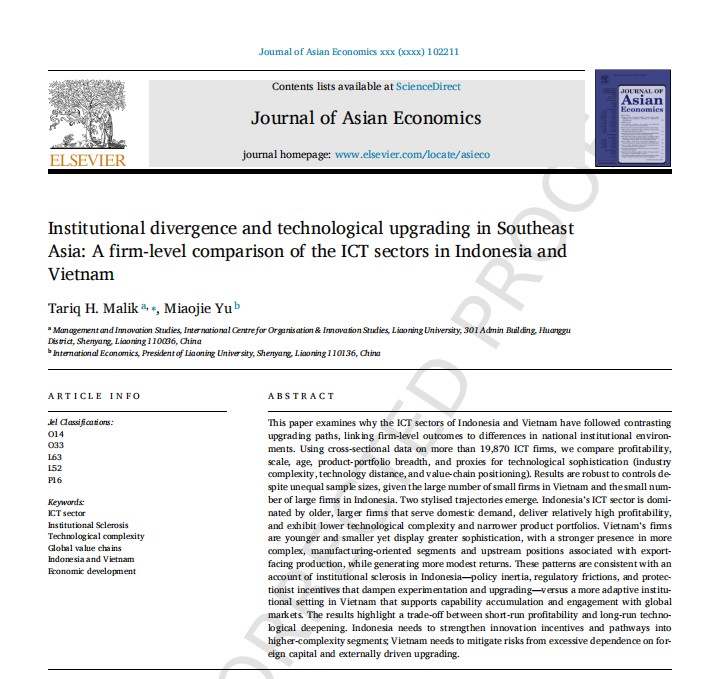
From the perspective of institutional disparities, this study focuses on a key phenomenon that why Indonesia and Vietnam, both ASEAN members exposed to identical global competitive pressures, have embarked on disparate paths of technological upgrading in the technological upgrading of Southeast Asia’s information and communications technology (ICT) industry. Drawing on micro-level data covering more than 19,800 ICT firms from Moody’s Analytics Orbis Database spanning 1970 to 2024, the paper conducts a comparative analysis of the ICT sectors in the two countries across multiple dimensions such as firm age, size, profitability, product portfolio breadth, technological sophistication, technology gap, and global value chain (GVC) positioning. Empirical results reveal that Indonesian ICT firms are more established, featuring longer operational histories, larger scales and stronger short-run profitability. Nevertheless, they suffer from lower technological sophistication, narrower product portfolios, and are predominantly confined to the domestic market and downstream segments of global value chains. By contrast, Vietnamese ICT firms are younger and smaller with limited short-term earnings, yet they exhibit higher technological complexity, broader product ranges, stronger manufacturing orientation, and deeper integration into global value chains. Such divergence stems from differentiated industrial upgrading trajectories shaped by distinct institutional environments. Indonesia is plagued by notable institutional rigidities, where policy inertia, regulatory frictions and protective incentives have dampened firms’ incentives for trial-and-error, market competition and technological upgrading. Vietnam, by contrast, boasts a more adaptive institutional framework that facilitates firms’ capability accumulation and participation in global markets. The paper further identifies a critical trade-off for ICT industrial upgrading in developing economies: robust short-term profitability does not automatically translate into long-term technological deepening, nor does industrial expansion equate to genuine capacity upgrading.
Introduction to the journal
Founded in 1990 by the American Committee for Asian Economic Studies (ACAES), the Journal of Asian Economics is ranked Q1 in JCR and Category 2 in the Chinese Academy of Sciences Journal Partition for Economics.
Download the paper

About the Authors

Yu Miaojie, deputy Party Secretary and President of Liaoning University; Fellow of the Royal Economic Society (FREcon), Member of the International Economic Association; Distinguished Chang Jiang Scholar and recipient of the National Science Fund for Distinguished Young Scholars; Deputy Editor-in-Chief of the Economic Journal, a top international economics journal; among the world’s top 1% highly cited economists in economics and management disciplines. He is the sole Chinese scholar to date to win the Royal Economic Society Prize. Chief Editor of China’s Open Economics, a key original textbook for philosophy and social sciences in China, and recipient of the Special Government Allowance from the State Council of the People’s Republic of China. He also serves as a deputy to the 14th National People’s Congress and a special supervisor of the National Supervisory Commission.

Tariq H. Malik, PhD in Management from University College London; Chief Economist of the Center for New Structural Economics at Liaoning University and Director of the International Center for Organization and Innovation Studies (ICOIS) at the Business School of Liaoning University. His research focuses on innovation and technology policy in organization and management studies. He has published in journals including Research Policy and International Business Review. He was a visiting scholar at University College London (2011–2013) and King’s College London (2012–2014), and works as an anonymous reviewer for academic journals such as Academy of Management Journal, International Business Review and R&D Management.