Recently, the School of International Education organized Chinese Government Scholarship recipients to conduct a cultural heritage study tour in Chaoyang City themed Perceiving China – Exploring Hongshan Culture, Conversing with the Dawn of Civilization. Centered on the World Heritage inscription initiative of Hongshan Culture and supported by the Kazuo Field Archaeology Practical Teaching Base of Liaoning University, the event guided international youth to step foot on archaeological excavation sites and trace the pulse of history. It enabled them to experience Chinese civilization amid profound cultural heritage, and promoted the international communication of Chinese civilization as well as exchanges and mutual learning among civilizations from a cross-cultural perspective.
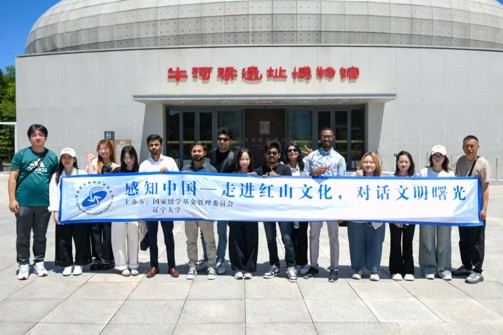
The faculty and student group first visited the Niuheliang National Archaeological Site Park to conduct an in-depth tour of the core sites of Hongshan Culture. As the most representative sacrificial site dating back to the late phase of Hongshan Culture, the Niuheliang Site provides tangible evidence for the 5,000-year-long history of Chinese civilization, and is hailed as a vital "direct root system" within the overall root system of Chinese culture. International students toured the Niuheliang Site Museum. Through displayed cultural relics, scene sand tables, multimedia presentations and other forms, they gained profound insights into the belief systems, craftsmanship standards and social organizational capabilities of prehistoric ancestors in China. They gained a deeper understanding of China amid excavation units and cultural strata, and perceived the essence of Chinese civilization through millennia of cultural accumulation.
Later, the international students visited the Kazuo Field Archaeology Practical Teaching Base of Liaoning University. Led by faculty members from the School of Archaeology and Museology, Liaoning University, the students visited dormitories, canteens, laboratories, cultural relics warehouses and other facilities of the base in sequence. They gained a comprehensive understanding of the daily work and living conditions of archaeologists, and learned in detail about excavation achievements at the South Erbuchi Site as well as the full workflow of field archaeology.
Chaoyang is known as the "Origin of Birds and Flowers", the land where the first bird took flight and the first flower bloomed. The group proceeded to the Liaoning Chaoyang Bird Fossil National Geopark and visited its Paleontological Fossil Museum. The international students explored signature exhibits including Sinosauropteryx prima and Liaoning Archaefructus and wandered through the petrified wood forest to witness the miraculous moments of life evolution hundreds of millions of years ago. The abundant paleontological fossil resources in Chaoyang offer a unique platform for international students to explore Earth’s history and biological evolution, allowing them to further appreciate the distinctive charm of western Liaoning from both natural and humanistic dimensions.
Integrating field archaeological practice with museum visits, this activity offered international students in China a precious immersive opportunity to experience the continuous inheritance of Chinese cultural lineage. Many international students commented that the tour not only deepened their understanding of the continuity and innovativeness of Chinese civilization, but also boosted cross-cultural communication and mutual learning between civilizations. As witnesses of Chinese civilization and young cultural ambassadors, they will share what they have seen, heard, learned and felt with broader audiences, actively promote Hongshan Culture to the world, and contribute youthful strength to telling authentic Chinese stories and amplifying China’s voice globally.
Translated by: Tan Ruomeng
Edited by: Gao Mengdi, Liu Hanlin
Proofread by: Li Zhibin
Reviewed by: Jin Jinghua