On the afternoon of October 8, Liaoning University (LNU) held the 33rd Bai Qinxian Distinguished Lecture in Conference Room 401 of the Administrative Building on Puhe Campus. Associate Professor Xing Yiqing from the National School of Development at Peking University was invited as the guest speaker. Professor Yu Miaojie, President of LNU, attended the lecture and delivered welcoming remarks. The lecture was moderated by Assistant Professor He Zhenyu of LNU’s Li Anmin Institute of Economic Research.
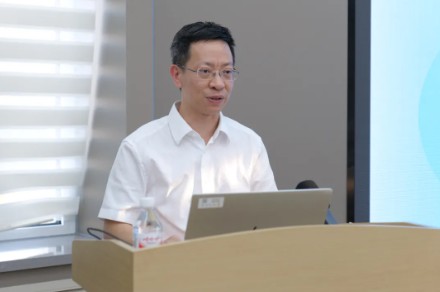
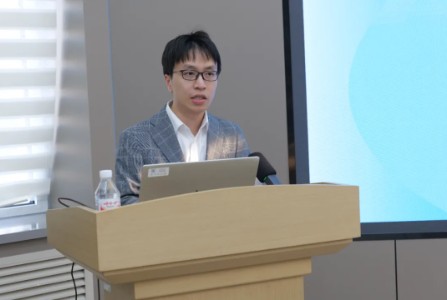
In his remarks, Yu Miaojie spoke highly of Associate Professor Xing Yiqing. Xing is a tenured associate professor of economics at Peking University’s National School of Development and a Peking University Boya Young Scholar. He also serves as Director of Research at the National School of Development, Deputy Director of the China Center for Economic Research, and Associate Editor of the Journal of Mathematical Economics. He studied at Peking University and Stanford University, earning his Ph.D. in Economics from Stanford. His research has appeared in leading Chinese and international journals, including Proceedings of the National Academy of Sciences (PNAS), The RAND Journal of Economics, Journal of the European Economic Association (JEEA), and Economic Research Journal. A representative paper coauthored with Matthew Jackson and published in JEEA reveals information spillovers and interactions between informal and formal institutions, providing an important theoretical foundation for understanding the complementarity between network-based cooperation and market institutions. His research spans economic and social networks, microeconomic theory, development economics, and the digital economy, with notable contributions to social networks, cooperation mechanisms, and informal institutions. Combining theoretical modeling with empirical analysis and focusing on the fundamental mechanisms of cooperation and governance, Professor Xing has offered influential and innovative insights into the economics of social networks, the digital economy, and development economics, providing valuable academic support for improving the allocation of social resources in China’s digital era.
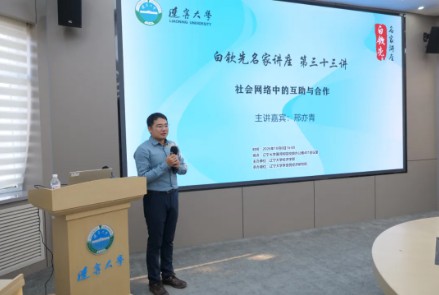
During the lecture, Associate Professor Xing Yiqing examined mutual assistance and cooperation mechanisms in social networks, exploring the economic implications of social networks as informal institutions and their theoretical and practical significance for mutual aid in the digital age. He explained that individuals are embedded in multiple, overlapping social relationships. Different relationships can serve as forms of “social collateral,” strengthening incentives for cooperation, but may also create “multiplex network traps” that lead to information cocoons, losses in transaction value, and inequality. There is an optimal range for the number of strong ties: too few may fail to cover the costs of mutual assistance, while too many can become burdensome. Addressing weaknesses is often more effective than reinforcing existing strengths. Formal institutions and informal network institutions are not simply substitutes; they can complement one another through information spillovers and interaction, making their coexistence potentially optimal. Turning to digital platforms, Xing drew on data from 4,569 medical crowdfunding campaigns on Shuidichou. He found that “narrow but distant” sharing networks significantly outperform “broad but close” networks in fundraising. Deeper diffusion can overcome network homophily and reach groups of higher socioeconomic status, producing benefits that outweigh the decline in altruism associated with greater social distance. Generalized Economic Connectedness (GEC) further indicates that indirect, deeper connections are crucial to fundraising effectiveness and resource allocation. Thus, in the digital age, social capital can extend beyond immediate social circles, profoundly shaping access to resources and inequality. Digital social networks are transforming mutual assistance and the allocation of social resources.
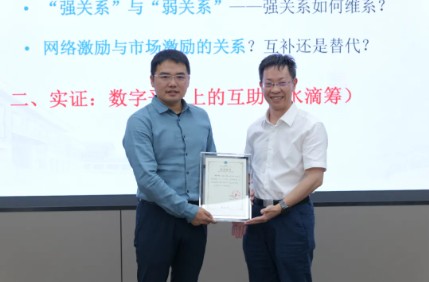
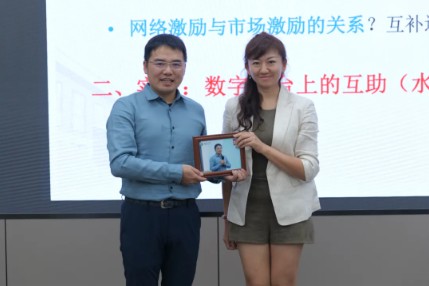
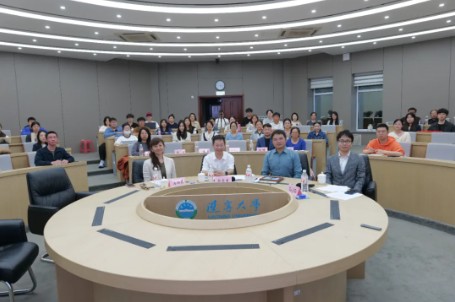
Following the lecture, President Yu Miaojie presented Xing Yiqing with a commemorative certificate for the Bai Qinxian Distinguished Lecture Series. Professor Ma Xiangjun, Deputy Dean of LNU’s China Economic Research Institute, presented him with a commemorative photograph. Participants then gathered for a group photo.
The lecture was organized by the Faculty of Economics of LNU and hosted by its Li Anmin Institute of Economic Research. More than 60 faculty members and students from units affiliated with the Faculty of Economics attended.
About the Speaker:

Xing Yiqing is a Peking University Boya Young Scholar, a tenured associate professor of economics at the National School of Development, and a recipient of the Overseas High-Level Young Talents Program. He also serves as Director of Research at the National School of Development, Deputy Director of the China Center for Economic Research, and Associate Editor of the Journal of Mathematical Economics. He earned a B.S. in Mathematics, a B.A. in Economics, and an M.A. in Economics from Peking University, followed by a Ph.D. in Economics from Stanford University. He previously taught at Johns Hopkins University in the United States. His research interests include economic and social networks, microeconomic theory, development economics, and the digital economy. His work has appeared in PNAS, The RAND Journal of Economics, Journal of the European Economic Association, Theoretical Economics, Journal of Political Economy Microeconomics, Economic Research Journal, and China Economic Quarterly, among other journals. His research honors include support from the Wu Jiapei Program for Information Economics Research, the Masahiko Aoki Economics Paper Award, and awards for innovative achievements in Chinese information economics.
Translated by: Tan Ruomeng
Edited by: Mark Moore
Proofread by: Mu Xiaolin
Reviewed by: Jin Jinghua