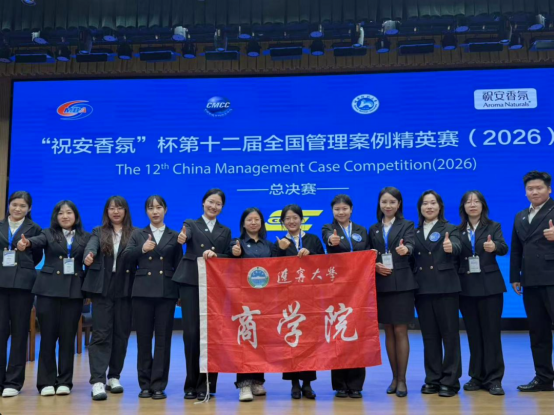
On October 25, the National Finals of the “Aroma Naturals Cup” 12th China Management Case Competition concluded at Hunan Normal University. The Liaoning University MBA team won the third prize in the national finals. Team member Wang Xinming received the Best Online Popularity Award, and Liaoning University received the Best Regional Organization Award, adding a new glorious chapter to its track record in this top-tier domestic management competition.
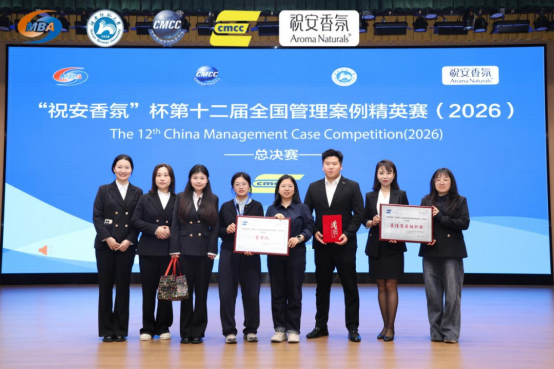
The China Management Case Competition is guided by the National Steering Committee for MBA Education and hosted by the China Management Case Sharing Center. It is one of the largest and most competitive practice-oriented competitions in the field of business administration education in China. This year’s national finals brought together 27 top teams advanced from various regional divisions. Centered on real enterprise cases, the competition involved intensive analysis and on-site debates, comprehensively testing the team’s strategic judgment, theoretical application capabilities, and teamwork skills.
In the previously held 12th Northeast Regional Qualifying Competition, the Liaoning University team won the regional championship with solid case analysis and excellent on-site performance, successfully securing a place in the national finals. During the finals, the Liaoning University team’s faculty and students repeatedly practiced case research, analytical framework development, presentation polishing, and mock Q&A. The advisors provided continuous guidance and feedback throughout the preparation, making the preparation process intense yet solid. Facing strong opponents, the team ultimately won the third prize in the national finals.
The Liaoning University MBA team had previously won the third prize in the National Finals of the 11th China Management Case Competition, achieving a historic breakthrough in this competition. Securing the third prize again in the 12th competition demonstrates that Liaoning University MBA is shifting from “an one-off breakthrough” to “sustained competitiveness” in this event, and the synergy between case-based education and practical competitions has become increasingly evident.
The university continues to strengthen the mechanism of case-based education, using cases as an important lever in graduate education and consolidating the educational foundation in four aspects. First, it deepens case development and cultivation by organizing faculty-student teams to conduct enterprise research and developing local cases on real business challenges, which has accumulated vivid materials for teaching and competitions. Second, it promotes the application of case teaching by integrating case development results into classroom teaching and improving students’ analytical and problem-solving abilities through case discussions, scenario simulations, and other methods. Third, it strengthens training for case competition, taking events such as the National Management Case Competition as testing platforms. Teams are selected through successive rounds of internal qualifying contests, and faculty advisors provide ongoing guidance throughout practical drills. Fourth, it builds case practice bases by organizing students to go into enterprises for mobile classes and integrated practical training, which has honed their practical abilities in real business scenarios. These four aspects support and reinforce each other, providing solid support for the MBA team to maintain its competitiveness in high-level competitions.
Translated by: Fu Zuoqi
Edited by: Mark Moore
Proofread by: Mu Xiaolin
Reviewed by: Jin Jinghua